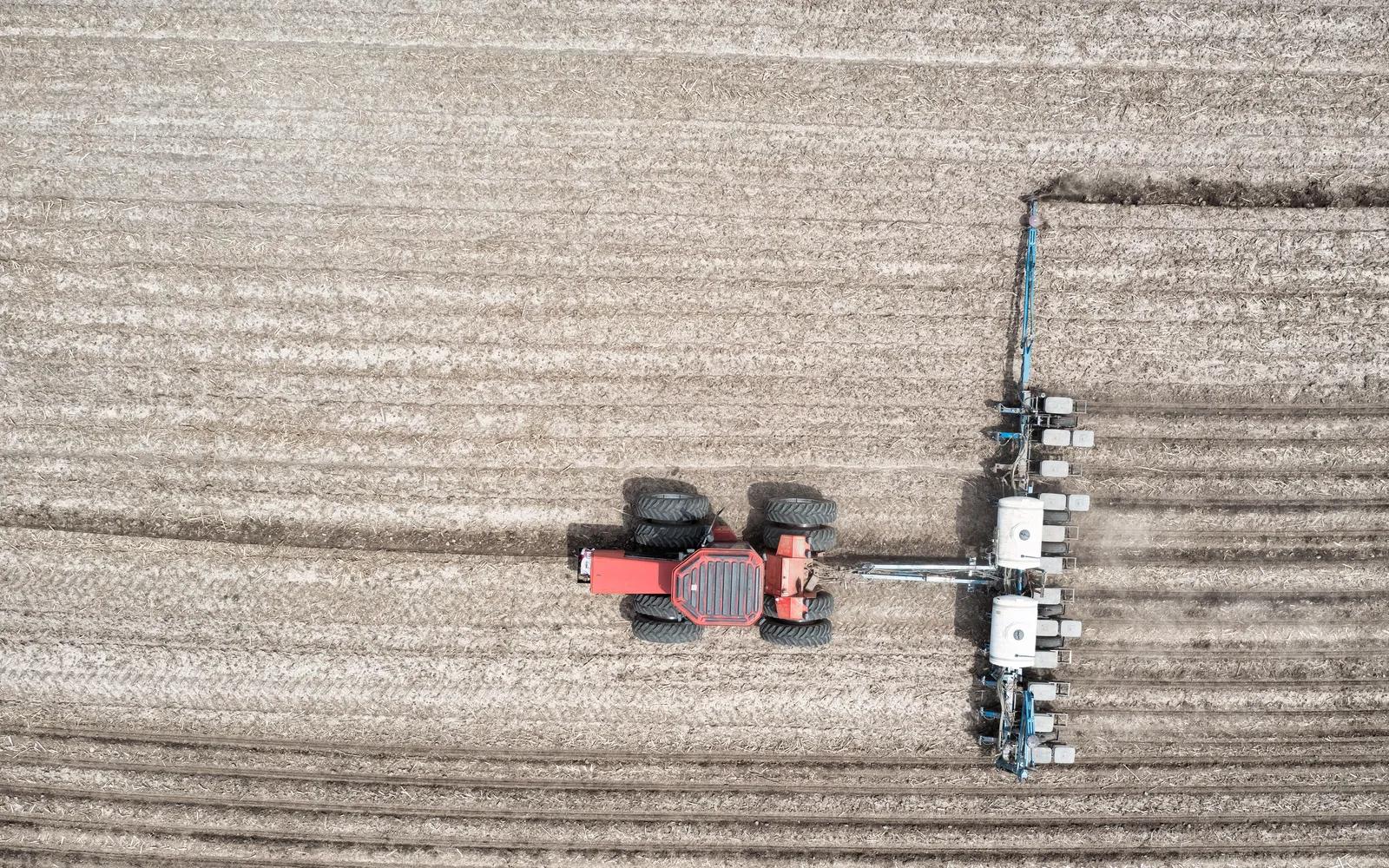
Farm equipment financing lets a farm pay for a tractor, combine, sprayer or irrigation system over several years, with the machine itself securing the deal instead of the land or everything else the farm owns. Today Capital Group is a business funding marketplace, not a lender, and through the funders in our network we arrange equipment financing up to $500,000 for tractors, combines and headers, sprayers and planters, irrigation, grain bins and handling equipment, and farm trucks and trailers. With a quote in hand, offers typically come back in one to two business days. Agricultural loans from the USDA's Farm Service Agency are a separate route, and the bills between planting and harvest usually fit a line of credit, or revenue-based financing when the farm has steady deposits.
US farms spent $21.0 billion on tractors and self-propelled machinery in 2024, up from $18.9 billion in 2023, plus $8.3 billion on other farm machinery, according to USDA's Farm Production Expenditures 2024 Summary, and about one farm in seven (14.3%) reported spending on tractors or self-propelled machines that year. The Economic Research Service's September 2026 farm income forecast puts net farm income at $158.4 billion for 2026, down 2.6% from 2025, with production expenses up 4.5% to $492.8 billion, and the farm sector balance sheet values machinery and motor vehicles at $366.9 billion for 2026. Paying cash for a machine drains the account that also covers seed, fertilizer and fuel, and financing spreads the cost over the seasons the machine will work.
How farm equipment financing works
The funder sends the money to the dealer or seller, and the farm repays over a set term with the equipment as collateral. Because the claim is on the machine rather than the land, the funder looks at two things: the equipment (its type, age, hours, price against market value and seller) and whether the farm can carry the payment, which it reads from business bank statements, time in business and credit. Terms commonly run two to seven years and follow the machine's working life, and the payments are fixed. Our equipment financing page lists what qualifies, and our guide to how equipment financing works compares loans with leases and covers Section 179.
| What the farm is buying | Examples | What to send with the application |
|---|---|---|
| Tractors and harvest equipment | Row-crop and utility tractors, combines and headers, balers | The dealer quote or seller's listing with year, hours and serial number |
| Planting and application equipment | Planters, drills, sprayers, spreaders | The quote with model and options listed |
| Irrigation | Center pivots, pumps and power units, drip systems | The installer's quote, with installation shown as its own line |
| Grain handling | Bins, dryers, augers, conveyors | The supplier's quote, and whether the equipment is permanent or portable |
| Trucks and trailers | Grain trucks, semis, livestock and flatbed trailers | The quote or listing with mileage and title details for used units |
Farm trucks follow the same rules as other work vehicles, which our guide to business vehicle loans covers along with the Section 179 weight limits. If you plan to buy at an equipment auction or a farm dispersal sale, arrange the money before you bid, as our guide to construction equipment financing explains for auction purchases.
New or used equipment and the down payment
A used tractor or combine can cost far less than a new one, and funders finance used farm equipment when the machine and the seller check out. Age and hours shorten the term, since a funder does not want the balance to outlast the machine, and a private sale may need an inspection or a lien check before the money moves. New equipment from a dealer usually gets the longest term and the simplest file. If the dealer offers its own financing, compare it with outside offers on the total of payments and the money due up front.
The down payment depends on the funder, the machine and the file. A larger one lowers every payment and can make a thinner file easier to accept, and a trade-in may count toward it if the funder agrees. The example below uses 15% down for illustration.
Ask for payments that follow the harvest
A monthly equipment payment keeps coming due in the months when a crop farm has the least money coming in. In Iowa, USDA's guide to usual planting and harvesting dates puts the most active corn planting between April 25 and May 18 and the most active harvest between October 5 and November 9. That leaves about five months between putting a crop in and harvesting it, and longer before it is sold when the grain goes into a bin.
When you apply, ask whether an annual or semiannual payment schedule timed to your harvest is available for your file. The answer depends on the funder and on how the farm is paid, and it can change which offer fits best. If the only offers are monthly, our guide to seasonal business loans shows how to test a set payment against your slowest month, and the same test applies to a tractor payment due in March.
A $180,000 used tractor, paid monthly or once a year
The figures below are an example only, not a quote or the terms of any funder. Say a grain farm buys a used row-crop tractor for $180,000 in December, puts 15% down ($27,000) and finances $153,000 over five years at an example interest rate of 9%. On the annual schedule, each payment falls due in December, after the crop is sold.
| Payment schedule (example) | Payment | Number of payments | Total of payments | Interest over the term |
|---|---|---|---|---|
| Monthly | $3,176.03 | 60 | $190,561.70 | $37,561.70 |
| Semiannual, if the funder offers it | $19,335.96 | 10 | $193,359.60 | $40,359.60 |
| Annual, if the funder offers it | $39,335.15 | 5 | $196,675.73 | $43,675.73 |
On the monthly schedule the farm pays about $38,112 a year in even amounts, including the months between planting and harvest when no crop money arrives. On the annual schedule a single $39,335 payment comes due each December, once the crop is sold, but the interest comes to about $6,114 more over the five years because the balance comes down more slowly. With the down payment, the tractor costs $217,562 on the monthly schedule and $223,676 on the annual one. A farm that keeps cash in the bank through the winter may prefer the monthly schedule and the lower total, while a farm that runs close to zero before harvest may prefer to pay more interest for a payment it can always make.
Agricultural loans from the USDA Farm Service Agency
Agricultural loans cover more than equipment, and the USDA's Farm Service Agency (FSA) lends to farmers and ranchers through its own programs. FSA makes direct loans itself and guarantees loans made by commercial lenders, and its farm loans fact sheet (October 2025) describes its credit as temporary, meant to carry a farm until it can borrow from a commercial lender. Today Capital Group does not place FSA loans. The figures below are general information from FSA's own pages, and applications go through a local FSA office.
| FSA program | What it pays for | Limit and term |
|---|---|---|
| Direct operating loan | Livestock, equipment, feed, seed, fuel, farm chemicals, insurance, family living expenses, minor repairs and some refinancing | Up to $400,000, with terms typically one to seven years |
| Guaranteed operating loan | The same uses, with a commercial lender making the loan and FSA guaranteeing it | Up to $2,558,000, adjusted each year for inflation |
| Farm ownership loan | Buying or enlarging a farm, building farm buildings, improvements and closing costs | Direct up to $600,000, and guaranteed loans within the same yearly limit as guaranteed operating loans, with terms up to 40 years |
| Farm Storage Facility Loan | Grain bins, hay barns, bulk tanks, cold storage, drying and handling equipment, and storage and handling trucks, new or used | Up to $500,000 for facilities and $100,000 for trucks, over 3 to 12 years, with 15% down (5% on loans up to $50,000) |
The first two rows come from FSA's farm operating loans page, the third from its farm ownership loans page and the last from the Farm Storage Facility Loan program, which a farm adding bins or a dryer can compare with commercial equipment financing. The fact sheet also says annual operating loans are generally repaid within 12 months or when the commodities produced are sold.
Operating loan applicants need a satisfactory credit history, the ability to repay and an inability to get credit elsewhere at reasonable rates and terms, and the application includes a farm business plan. Direct operating loans also ask for education, training or at least a year of experience running a farm within the last five years. FSA credit suits a farm that meets those tests or is buying land. A farm that qualifies with commercial funders, or needs a machine before the next sale date, can compare equipment financing alongside it.
Paying for seed, fertilizer and fuel before harvest
Seed, fertilizer, chemicals and fuel are paid for around planting, labor and repairs run through the summer, and a grain farm sells in the fall or later from storage. ERS forecasts fertilizer, lime and soil conditioner spending up 15.3% in 2026 and fuel and oil up 28.8%, so the amount a farm carries until harvest grows with them.
A business line of credit up to $2,000,000 fits costs that arrive in stages. The funder sets a limit, you draw what each bill needs, and you repay weekly or monthly on what you have drawn, with the room coming back as you repay. Offers come back in one to two business days, and some programs discount an early payoff. Because repayment is weekly or monthly, a line works best for a farm with money coming in during the season, such as milk checks, cattle sales, produce sold every week or custom work, or for covering a few weeks until a contract payment or grain sale arrives. Our guide to how a business line of credit works covers draws and repayment in more detail.
Revenue-based financing for farms with steady deposits
Revenue-based financing from $5,000 to $2,000,000 is a merchant cash advance. The funder buys part of the farm's future sales in advance, sizes the amount on its usual revenue and collects a set daily or weekly payment until the agreed total is paid. Most applicants are funded within one to two business days of choosing an offer, the decision rests mainly on four months of business bank statements, and it usually needs no collateral, which suits a breakdown at harvest. The cost is a factor rate. As an example, a $50,000 advance at a factor rate of 1.28 has a total payback of $64,000, so the cost is $14,000, repaid in 40 weekly payments of $1,600.
Funders read deposits from the farm's bank statements, so the fit depends on how the farm is paid. A dairy paid for its milk twice a month, a cattle or poultry operation with sales through the year, or a market garden selling every week in season shows the steady deposits an advance is sized on. A grain farm that deposits one or two large sale checks a year usually does not, because four months of statements can show almost nothing coming in, and equipment financing or an FSA loan is the better place to start. If other steady income runs through the business account, such as custom work, trucking or a farm store, have twelve months of statements ready so a funder can see it.
The funders we work with generally look for about a year in business and about $20,000 a month in deposits. If you're not there yet, apply anyway. Some funders work with newer or smaller businesses, and we'll tell you what's realistic.
Which option fits your farm
- Equipment financing up to $500,000 suits a farm buying a specific machine, irrigation system, bin or truck it will use for years.
- An FSA direct or guaranteed loan suits a farm that meets FSA's eligibility tests or is buying land or putting up buildings.
- A line of credit up to $2,000,000 suits input and labor bills that arrive in stages, for a farm with income during the season.
- Revenue-based financing from $5,000 to $2,000,000 suits a farm with steady deposits that needs money within days.
How to apply through Today Capital Group
Start with the short application and four months of business bank statements as PDFs, plus the quote or listing for the equipment with its year, hours and serial number. Getting matched does not need a hard credit pull, since most funders prequalify from bank statements and a soft pull, and if a funder runs a hard pull in final underwriting you will know first. One application goes to the funders in our network, the offers come back side by side, and we go through the payment, the term and the total cost with you before anything is signed, including whether a funder will set the payments around your harvest. There is nothing to pay to apply or to see offers. To talk through a machine or a season first, call (818) 351-0225.
Frequently asked questions
What is farm equipment financing?
Farm equipment financing pays for a tractor, combine, sprayer, irrigation system, grain bin or farm truck over a set term, with the equipment securing the deal, and through the funders in our network it runs up to $500,000 with offers typically in one to two business days.
Can I finance used farm equipment?
Used tractors, combines and other farm machines can be financed when the machine and the seller check out, though older machines with more hours usually get shorter terms, and a private sale may need an inspection or a lien check before the money moves.
What agricultural loans does the USDA offer?
The USDA's Farm Service Agency makes direct farm operating loans of up to $400,000 and direct farm ownership loans of up to $600,000, guarantees larger loans made by commercial lenders, and finances grain bins and handling equipment through its Farm Storage Facility Loan program; applications go through local FSA offices, and Today Capital Group does not place these loans.
Can farm equipment payments be made once a year?
Whether a funder will set annual or semiannual payments timed to your harvest depends on the funder and the file, so ask before you sign; in our example, $153,000 at 9% over five years costs about $6,114 more in interest on an annual schedule than on a monthly one.
How long can you finance a tractor?
Equipment financing terms commonly run two to seven years and follow the machine's working life, so a new tractor usually gets a longer term than an older one with high hours, and a longer term means a lower payment and a higher total paid.