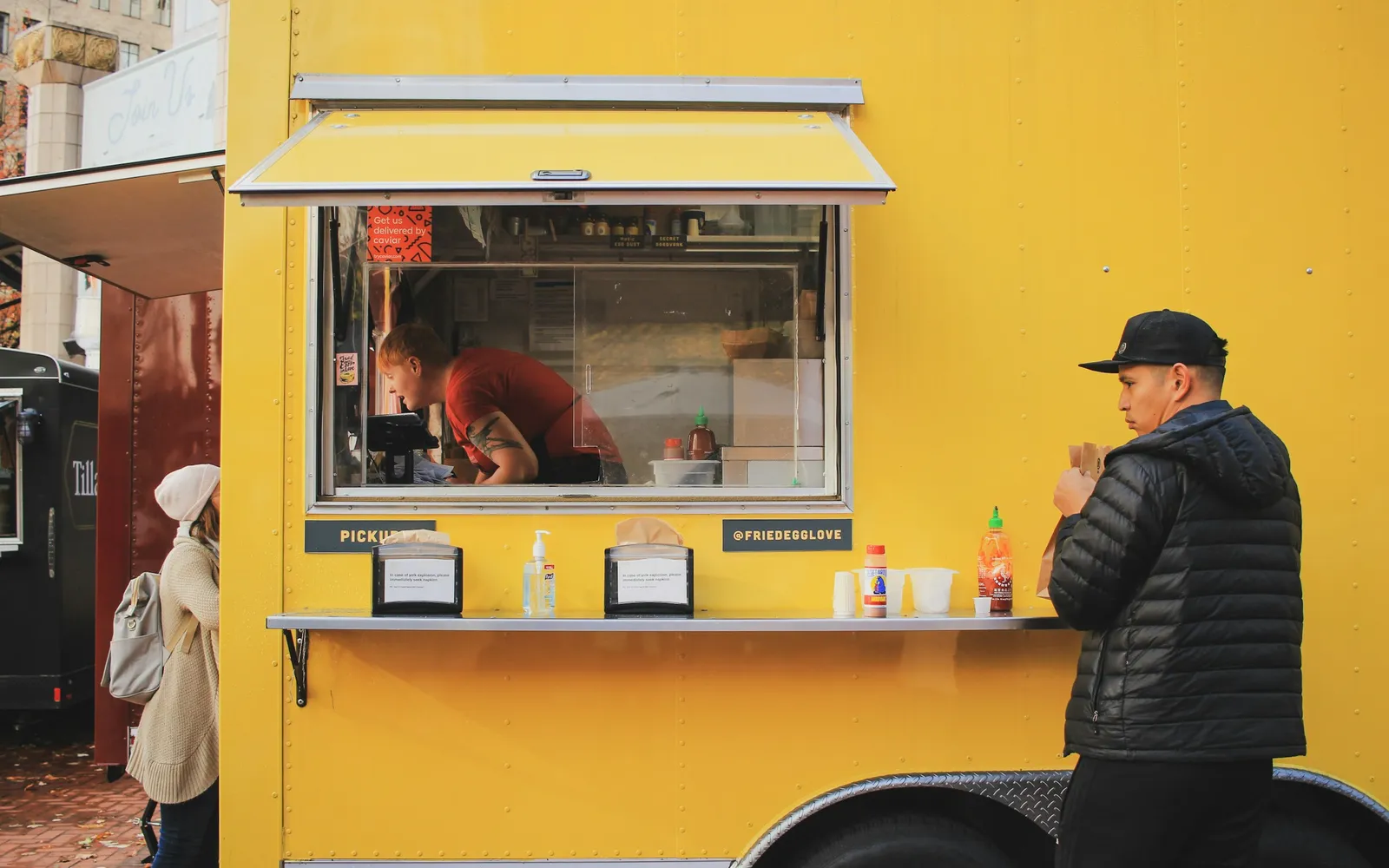
Food truck financing usually comes in one of two shapes, depending on whether the truck is already selling. If you are buying a truck or trailer, the most common route is equipment financing, where the vehicle and its kitchen secure the deal, with an SBA microloan or 7(a) loan as the slower, longer-term choice for a new operator. If your truck is already open and taking card payments, revenue-based financing or a business line of credit can pay for a repair, a second truck or the stock for a busy season, often within a few business days. Which food truck loan fits depends on how long you have been operating, what your deposits look like, and what the money is for.
Below we cover start-up costs, how each option works for a mobile kitchen, and what funders look at. Our funding page for restaurants and food businesses gives the shorter version, and if you also run a fixed location, our restaurant financing guide covers the dining room side.
What it costs to start a food truck
The truck is the largest single cost, and the range is wide because a step van with a full custom kitchen and a used trailer with a griddle and a fryer are very different purchases. CNBC, reporting on the industry in 2025, put industry estimates for the truck at $120,000 to $200,000. A trailer usually costs less than a motorized truck of the same size, but it needs a tow vehicle, and some events and parking spots only take one or the other, so check where you plan to sell before you choose.
Permits and compliance are the cost new operators tend to underestimate. The U.S. Chamber of Commerce Foundation's Food Truck Nation study looked at the rules in 20 cities and found that starting and keeping a food truck running for one year took, on average, 45 separate government-mandated procedures, 37 business days and $28,276 in permits, licenses and ongoing legal compliance. That average covers cities with very different rules, so your own figure could be well above or below it.
Most trucks also need a commissary, a licensed kitchen where the truck is cleaned, restocked and often parked. In California, for example, Sonoma County's summary of mobile food facility rules says food preparation units must operate out of a commissary and report to it at least once each operating day for cleaning and servicing. WebstaurantStore, a restaurant supply retailer, puts average commissary rent at $250 to $750 a month, and $1,000 to $1,250 in high-cost cities such as Manhattan or Los Angeles.
Then there is the point of sale. A food truck runs on card payments, so the POS belongs in the build budget from the start. The U.S. Chamber of Commerce's guide to POS systems says a card reader costs under $200, a fixed hardware bundle can cost over $2,000, and the software ranges from free to over $200 a month.
| Start-up cost | Sourced range | Source |
|---|---|---|
| Truck | $120,000 to $200,000 (industry estimates) | CNBC, 2025 |
| Permits, licenses and compliance for the first year | $28,276 on average across 20 cities | U.S. Chamber of Commerce Foundation |
| Commissary | $250 to $750 a month, $1,000 to $1,250 in the costliest cities | WebstaurantStore |
| POS | Card reader under $200, hardware bundle over $2,000, software free to over $200 a month | U.S. Chamber of Commerce |
On top of those, plan for insurance, opening stock, fuel and propane, a wrap, and enough cash to cover a few slow weeks while the truck builds a following.
Food truck loan and financing options
There are five main ways to pay for a truck or keep one running. The first two suit buying a truck, the next two suit a truck that already has sales, and the last comes from whoever sells you the truck.
Equipment financing for the truck or trailer
Equipment financing pays for a specific truck, trailer or piece of kitchen equipment and uses it as security. Because the funder can recover the vehicle if payments stop, approval tends to be easier than for unsecured credit. In the Federal Reserve Banks' 2025 Report on Employer Firms, 68% of applicants for auto or equipment loans were fully approved, the highest share of any product in the survey. Offers through our network typically come back within one to two business days.
Equipment financing also works for a food truck for sale from a builder, a dealer or another operator. The funder will want a quote or bill of sale, the vehicle identification number and details of the build, and a newer truck with a clear title is easier to finance than an old one with an unknown history. Expect to put some money down on a first truck. Our equipment financing page lists what it covers, and our guide to how equipment financing works goes through terms, down payments and loans versus leases in more detail.
SBA microloans and 7(a) loans for new operators
For someone starting out, the SBA programs are often the most realistic long-term option. The SBA's microloan program lends up to $50,000 through nonprofit intermediary lenders, and the money can go to working capital, inventory, supplies, machinery and equipment. It cannot be used to pay existing debts or buy real estate. We don't make SBA loans ourselves, but through our partners we offer SBA-equivalent loans, and the partner makes the credit decision. A microloan rarely covers a whole new truck on its own, but it can cover a used trailer, the kitchen equipment, or the opening stock and permits alongside equipment financing.
The 7(a) program goes up to $5 million and covers machinery and equipment, working capital and furniture, fixtures and supplies, so a single 7(a) loan can pay for the truck and the opening costs together. It takes weeks rather than days, and the lender will ask for tax returns, a personal financial statement, a schedule of existing debts and, for a new business, a business plan with projections. For a larger start-up project, our partners' SBA-equivalent loans can play the same role, with the partner deciding. Our guides to startup business loans and SBA loan requirements cover what a first-year business needs to bring.
Revenue-based financing for a truck that is already selling
Once a truck has a few months of card sales in its bank account, revenue-based financing becomes an option. A funder pays you now for a portion of your future sales, and you repay a set daily or weekly amount over a set term. The amount is sized on what the business usually brings in, which is why the decision rests mainly on your last four months of business bank statements rather than on collateral or a high credit score. Advances arranged through us range from $5,000 to $2,000,000, and most applicants are funded within one to two business days of choosing an offer.
The cost is set as a factor rate, so you know the total in dollars before you sign. As an example, a $30,000 advance at a factor rate of 1.30 means $39,000 paid back in total, which could be a set payment of $1,500 a week for 26 weeks. That speed and that fixed total make it a good fit for jobs a food truck cannot wait on, such as a generator, a refrigeration unit or a transmission that fails in the middle of the season, the down payment on a second truck, or a full stock of food and packaging before festival season. Our revenue-based financing page covers amounts, timing and fit.
A business line of credit
A line of credit gives you a limit, up to $250,000 through our network, and you draw only what you need. You repay what you drew on a weekly or monthly schedule, and as you repay, the room opens up again without a new application. For a food truck, a line suits the costs that come back every year, like event and festival fees paid weeks before the event, commissary rent and insurance through the winter, or a large order of supplies before a run of catering jobs. Our guide to the business line of credit explains limits, draws and repayment.
Builder or dealer financing and leasing
Many truck builders and dealers arrange financing or a lease for the trucks they sell, either through their own program or through a lender they work with. This is convenient, because the paperwork happens where you buy, and a lease can lower what you pay at the start. Terms vary between programs, so compare the total of all payments, the term, any down payment and, for a lease, what it costs to own the truck at the end. A second quote through equipment financing lets you set the two side by side.
Seasons, events and the commissary
Food truck sales follow the weather, the event calendar and where you are allowed to park. A truck in a cold-winter city may do most of its year between spring and fall, while a truck that books weddings, office lunches and festivals can have a very different pattern from one that sells on the street. Ben Goldberg of the New York Food Truck Association told CNBC that many of the association's most successful members earn the majority of their revenue from private events, brand activations and catering rather than street vending. Catering often pays on invoice, which can leave a gap between buying the food and getting paid.
The fixed costs do not follow the same calendar. Commissary rent, insurance and the truck payment are due in February as well as in July. The practical answer is to size any payment against what the truck does across a normal year, not against its best month, and to arrange working capital before the busy season starts rather than in the middle of it. A revenue-based advance has a set payment, so you can plan it around the months you know are slower, and a line of credit lets you draw for slow-month bills and pay the balance down once the season picks up.

How hard is it to get a food truck loan?
It depends mostly on whether the truck is already selling. A first truck with no sales history is financed on the truck's value, your credit, your down payment and your plan, which is why equipment financing and SBA programs are the usual starting point. An operating truck is judged mainly on its deposits, which opens up revenue-based financing and lines of credit as well. Four things come up in almost every file.
- Time operating matters because a funder wants to see sales through more than one season, and a truck that has been through a winter shows how it handles one.
- Deposits matter most for revenue-based financing and lines of credit, since funders read your business bank statements to see how much comes in, how steady it is, and how the account handles the low months.
- Credit matters more to some funders than others, and a low score narrows the list of options rather than ending the search.
- The truck's value matters for equipment financing, so the age, mileage, build quality and title of the vehicle all affect the offer.
The funders we work with generally look for about a year in business and about $20,000 a month in deposits. If you're not there yet, apply anyway. Some funders work with newer or smaller businesses, and we'll tell you what's realistic, including whether a microloan or equipment financing is the better first step. Getting matched does not need a hard credit pull, since most funders prequalify from bank statements and a soft pull. A funder may run a hard pull in final underwriting, and you will know before it does.
Food businesses are familiar territory for the funders in our network, and our food business funding page explains which structures tend to fit trucks, caterers and restaurants.

How to apply
- Fill in the short application and say what the money is for, because a new trailer, a broken generator and stock for festival season call for different products.
- Upload your last four months of business bank statements or connect your bank read-only. For equipment financing, add the quote or bill of sale for the truck, and for an SBA loan, have tax returns, a personal financial statement and a list of current debts ready.
- We send your file to the funders in our network that fit your situation, bring their offers back side by side, and go through the total cost, payment and term with you before anything is signed.
- Most applicants are funded within one to two business days of choosing an offer, and some the same day, while SBA loans take several weeks.
There is nothing to pay to apply or to see offers, and no obligation to take one. If you would rather talk it through first, call us at (818) 351-0225.
Food truck financing questions
How hard is it to get a loan for a food truck?
It is easier for a truck that is already selling than for a first truck, because an operating truck can be judged on its bank deposits while a new one is judged on the truck's value, the owner's credit and the plan. Equipment financing is often the most approachable route for a purchase, since the truck secures the deal, and in the Federal Reserve's 2025 small business survey auto and equipment loans had the highest full approval rate of any product.
How to get funding for a food truck?
Price the truck or trailer, permits, commissary and POS first, then match each cost to a product: equipment financing or an SBA loan for the truck, an SBA microloan for smaller start-up costs, and revenue-based financing or a line of credit once the truck has card sales. Our application takes a few minutes, and we bring the offers back side by side.
Can you finance a food truck with bad credit?
Often you can, though with fewer options. Equipment financing uses the truck as security and revenue-based funders rely mainly on bank deposits, so a low score narrows the list of funders rather than ending the search.
Can you get an SBA loan for a food truck?
Yes, SBA microloans of up to $50,000 and 7(a) loans of up to $5 million can both be used for equipment and working capital, which covers a truck and its opening costs. They take weeks and need more paperwork than other options, and through our partners we offer SBA-equivalent loans for the same purposes.
What credit score do you need for a food truck loan?
There is no single number, because every lender and funder sets its own threshold and credit matters more to some than to others. A stronger score widens your options and can improve the terms, while a lower score usually means relying more on the truck's value or on your deposits.