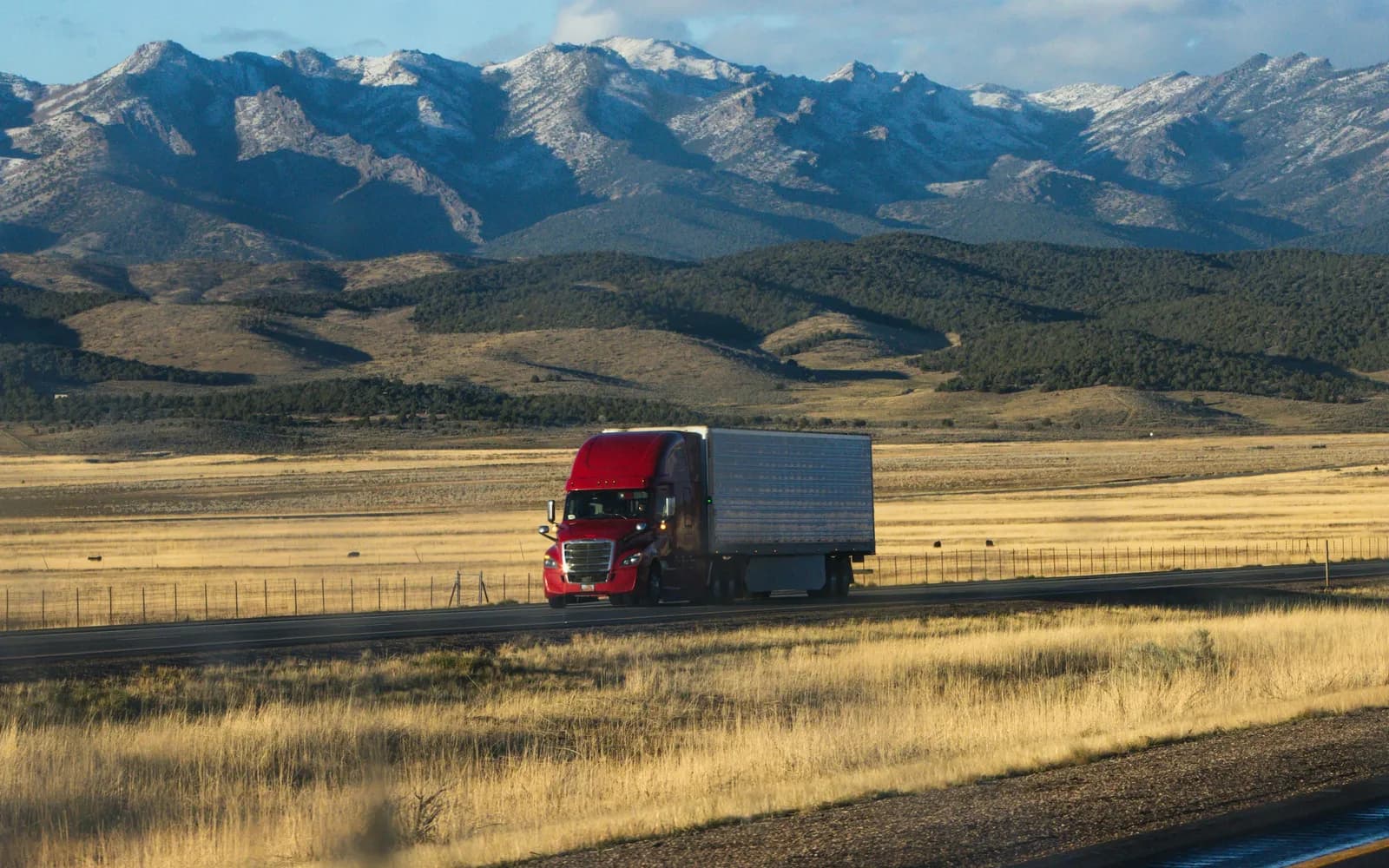
Small fleets and owner-operators cover trucking fuel costs by combining three things: a trucking fuel card for discounts and a short float at the pump, a fuel surcharge that passes part of the diesel price to the customer, and funding such as a line of credit for the 30 to 45 days until the broker or shipper pays. The card and the surcharge reduce what fuel takes out of each load, but neither one changes when the money arrives, and that wait is what the funding covers. Our guide to trucking business financing covers trucks, repairs and insurance.
What diesel costs per gallon and per mile
The U.S. Energy Information Administration's weekly survey put on-highway diesel at $6.292 a gallon on November 2, 2026, taxes included, which was $2.539 above the year before. The same survey showed $5.912 on the Gulf Coast and $7.272 on the West Coast. The weekly history ran from $3.459 on January 12, 2026 to $6.529 on September 21, 2026. EIA updates the figure every Tuesday, so check it before you price a load.
To turn a pump price into a cost per mile, divide it by your miles per gallon. At 6.5 mpg, $6.292 a gallon comes to 96.8 cents a mile. We use 6.5 as a round example, a little under the 7.1 mpg the Federal Highway Administration reports for combination trucks in its 2024 highway statistics, and your own figure is on your IFTA return.
How to work out your trucking cost per mile
Your cost per mile is everything the truck cost in a period divided by all the miles it ran, including empty ones. The American Transportation Research Institute's 2026 analysis of operational costs put the 2025 industry average at $2.336 a mile, and $1.854 a mile excluding fuel. That leaves fuel at about 48 cents, or about 21% of the total, in a year when EIA's weekly diesel readings averaged about $3.66 a gallon.
Here is one example truck running 2,500 miles in a week, with fuel at the November 2 price and everything else at ATRI's 2025 averages. The driver line uses the 81.8 cents in wages and 21 cents in benefits reported by Transport Topics, and an owner-operator would put in the pay they need to take home.
| Cost for one example truck, 2,500 miles in a week | Week | Per mile |
|---|---|---|
| Fuel, about 385 gallons at $6.292 | $2,420 | $0.968 |
| Driver wages and benefits | $2,570 | $1.028 |
| Truck and trailer payments, repairs, insurance, tires, tolls and permits | $2,065 | $0.826 |
| Total | $7,055 | $2.822 |
Fuel comes to about 34% of this truck's cost per mile. A load paying under $2.822 for every mile it takes to run, empty miles included, loses money at these costs, so keep your own version of this number in front of you when you quote.
How to calculate a fuel surcharge and ask for one
A fuel surcharge is an added charge, per mile or as a percentage of the line haul rate, that covers the part of the diesel price above an agreed level. There is no official formula. EIA says it does not calculate or regulate surcharges, that every company has its own method, and that many shippers and truckers use its weekly price in their formulas. A common per-mile formula is the index price minus the peg price (the diesel price your base rate already assumes), divided by an agreed miles per gallon.
| Step in this example | Figure |
|---|---|
| Index price, EIA U.S. average for November 2, 2026 | $6.292 |
| Peg price, close to EIA's January 2026 readings | $3.50 |
| Difference | $2.792 a gallon |
| Agreed miles per gallon | 6.5 |
| Fuel surcharge per mile | About 43 cents |
| Fuel surcharge on a 1,000-mile load | About $430 |
The base rate still has to carry the first $3.50 of every gallon, which is about 54 cents a mile at 6.5 mpg. Some schedules use a percentage instead. The General Services Administration's freight schedule, in the version effective October 1, 2021, adds 1% to the line haul charge for each 13 cents EIA's national average sits above $2.50, which works out to about 30% at $6.292.
Direct shippers and contract lanes are the natural place to ask, because the rate stays on paper for months. Spot loads from brokers are often quoted as one all-in rate, so there you check that the rate covers your fuel at that week's price before you accept.
- Bring your cost-per-mile figure and propose every term in one sentence, for example "EIA U.S. weekly average, $3.50 peg, 6.5 mpg, reset every Tuesday, paid on all billed miles."
- Agree on the index for the lane, since a West Coast lane priced off the national average would have been 98 cents a gallon short on November 2, 2026.
- Put the schedule in the contract or on each rate confirmation, and show the surcharge as its own line on the invoice.
- If you are leased on to a motor carrier, ask in writing how much of any surcharge reaches you, because federal leasing rules at 49 CFR 376.12 require the lease to state clearly what you are paid.
A surcharge is billed with the load and paid on the same terms as the rest of the invoice, so it recovers cost without shortening the wait.
How a trucking fuel card works and what to compare
A trucking fuel card is a payment card for diesel, usually issued to the company with one card per truck or driver. You set what each card can buy, and the issuer reports every fill by truck, gallons and location. Some cards bill on a set cycle against a credit limit, which gives you days of float, and others are prepaid. We do not issue fuel cards, so the table below is what to ask any issuer.
| What to compare | What to ask | Example |
|---|---|---|
| Discount | Is it a set amount off the pump price or the station's cost plus a fee, and which stations on your lanes honor it? | 30 cents off 1,923 gallons is about $577 a week |
| Fees | What are the charges per card, per transaction, out of network and for late payment? | A $2 fee on 15 fills a week takes back $30 |
| Credit terms | What is the limit, how many days do you get to pay, and is a personal guarantee required? | 14 days to pay on $12,100 a week keeps about $24,200 in your account |
| IFTA reporting | Does the report show the date, seller, gallons, fuel type, price, truck and purchaser? | A record missing those fields can lose the tax-paid credit |
A limit set when diesel was $3.50 buys about 44% fewer gallons at $6.292, so a card that once covered the whole week can decline at the pump midweek. Ask the issuer for a review before that happens.
IFTA quarterly filing and your fuel records
If your trucks cross state lines, fuel tax runs through the International Fuel Tax Agreement. According to IFTA, Inc., it generally applies when a qualified motor vehicle (two axles and over 26,000 pounds, three or more axles, or a combination over 26,000 pounds) operates in two or more member jurisdictions. You file with your base jurisdiction every quarter. Returns are due April 30, July 31, October 31 and January 31, with the next business day applying when a date falls on a weekend or legal holiday.
The return reports your miles and gallons, your average miles per gallon and, for each jurisdiction, the gallons your miles used and the tax-paid gallons you bought there, so it can leave tax due in one state and a credit in another. The penalty for a late or short return is $50 or 10% of the delinquent tax, whichever is greater, so put those four dates on the same calendar as your broker payments. Keep trip and fuel records for at least four years. IFTA's Procedures Manual (section P550) accepts a third party's transaction listing, such as a card report, as proof of tax-paid fuel if it shows the details in the table above. This is general information, and your base jurisdiction has the final word on how to file.
A 5-truck fleet's weekly fuel bill against broker payment timing
Here is the timing in dollars, as an example only. Five trucks each run 2,500 miles a week at 6.5 mpg, so the fleet buys about 1,923 gallons a week, and at $6.292 a gallon the fuel bill is $12,100 a week. On 30-day terms the first broker payment arrives about four weeks after the first load, and on 45-day terms about six weeks after.
| Example fleet, $12,100 of fuel a week | 30-day terms | 45-day terms |
|---|---|---|
| Weeks of fuel paid before the first payment arrives | 4 | 6 |
| Fuel paid by then, with no float | $48,400 | $72,600 |
| Fuel paid by then, with a card that gives 14 days to pay | $24,200 | $48,400 |
Once invoices clear every week the amount stops growing, because each week's payment covers an earlier week's fuel, but the balance stays for as long as the trucks keep running.
The chart shows one truck and counts truck payments as well as fuel, at 2024 costs, when fuel averaged about 48 cents a mile. That is why its $2,180 a week is lower than the $2,420 this example truck spends on fuel alone at 96.8 cents a mile.

A line of credit for the fuel gap that repeats
A gap that comes back with every load fits a line of credit of up to $2,000,000 through our network. You draw when the fuel bill is due, repay weekly or monthly on what you have drawn, and the limit opens up again as broker payments arrive. Offers typically come back in one to two business days. Our example fleet on 45-day terms with a 14-day card carries about $48,400 in fuel, so it might look for a limit near $50,000, which a funder would set from its deposits and the rest of its file. Our guide to business cash flow loans explains how funders read those deposits.
Lines are priced in different ways, and the weeks a draw stays out decide the dollars. On a $20,000 draw repaid in six weeks, about the time a 45-day invoice takes to clear, the example below comes to about $323 with interest that starts near $92 a week and shrinks with the balance, $2,000 with a flat 1.10 factor fee, and about $1,231 with a flat fee and an early payoff discount. Our comparison of a line of credit and a term loan goes through how each one is priced.
Revenue-based financing for a one-time fuel run
Say the same fleet wins a contract that adds 5,000 miles a week on 30-day terms. At 96.8 cents a mile the new lanes burn $4,840 of fuel a week, or $19,360 before the first payment arrives. Revenue-based financing from $5,000 to $2,000,000 is built for that kind of deadline. Most applicants are funded within one to two business days of choosing an offer, the decision rests mainly on four months of business bank statements, and it usually needs no collateral.
It is a merchant cash advance, which means the funder buys part of your future sales in advance, sizes the amount on your usual revenue and collects a set daily or weekly payment until the agreed total is paid. As an example, a $20,000 advance at a 1.20 factor rate has a total payback of $24,000, so the cost is $4,000, and 12 weekly payments of $2,000 would clear it. The new lanes would run 60,000 miles in those 12 weeks, so the $4,000 works out to about 6.7 cents a mile, a figure you can set against the margin on the contract before you sign.
Broker deposits tend to arrive in lumps, so choose a payment your usual week can carry. Our guides to how daily and weekly payments work and how much you can get with a merchant cash advance have more examples.
Factoring, fuel advances and newer trucks
Other owners close the same gap with freight factoring, which we do not arrange. A factoring company buys your unpaid invoices, pays most of their value up front and collects from the broker, for a fee on each invoice. Some factors also pay a fuel advance, a part of the load's rate at pickup, and take it back at settlement. Our trucking financing guide compares factoring with a line of credit and an advance. If you already factor, tell us when you apply, because the agreement decides which funders can look at the file.
Moving from 6.5 to 7.5 mpg saves about 13 cents a mile at $6.292, or about $323 a week on 2,500 miles, and equipment financing up to $500,000 can pay for a newer truck, as our guide to business vehicle loans explains.
How to apply for fuel funding through us
Start with the short application and four months of business bank statements, uploaded as PDFs or emailed to us. Getting matched does not need a hard credit pull, since most funders prequalify from bank statements and a soft pull. A funder may run a hard pull in final underwriting, and you will know first. The funders we work with generally look for about a year in business and about $20,000 a month in deposits. If you're not there yet, apply anyway, because some funders work with newer or smaller businesses and we'll tell you what's realistic.
One application goes to the funders in our network, the offers come back side by side, and we go through them with you before anything is signed. There is nothing to pay to apply or to see offers. Our trucking funding page shows how we work with carriers, and you can call (818) 351-0225 to go through your fuel numbers first.
Frequently asked questions
How do trucking companies pay for fuel before brokers pay?
Small fleets usually combine a fuel card with a fuel surcharge on contract freight and a line of credit, factoring or cash reserves for the 30 to 45 days until the broker or shipper pays.
How do you calculate a fuel surcharge?
A common method subtracts the agreed peg price from the weekly index price and divides by the agreed miles per gallon, so a $3.50 peg, a $6.292 index and 6.5 mpg give a fuel surcharge of about 43 cents a mile.
What is the average trucking cost per mile?
The American Transportation Research Institute put the 2025 industry average at $2.336 a mile, with fuel at about 48 cents of that, and you find your own figure by dividing a period's total costs by all the miles run, including empty ones.
When are IFTA returns due?
IFTA returns are due April 30, July 31, October 31 and January 31 for the quarters ending in March, June, September and December.
Can a line of credit pay for fuel?
Yes, you can draw on a line of credit when the fuel bill is due and repay weekly or monthly on what you have drawn, and through our network lines go up to $2,000,000.